Construction logistics planning for constrained urban sites
Admin · 22 October 2026
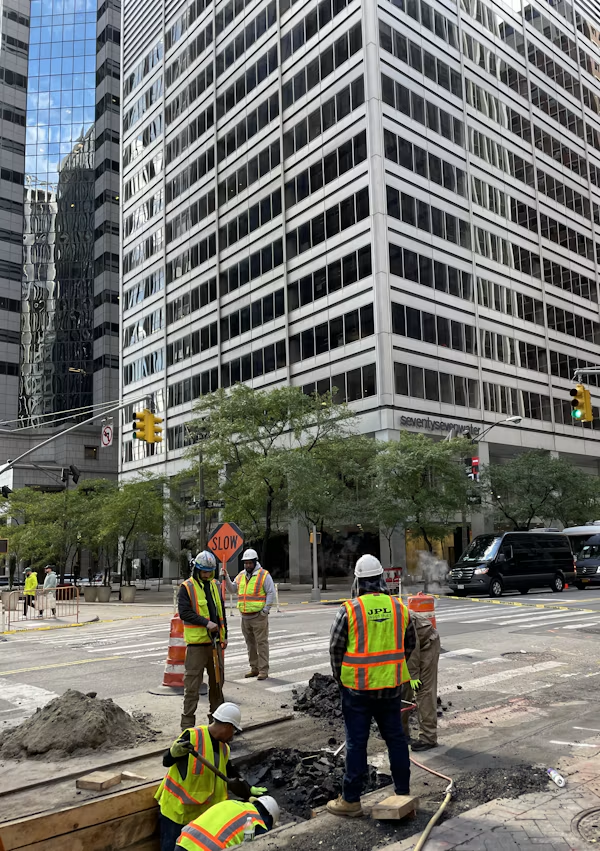 Illustrative image. Photo by Narno Beats on Unsplash. Unsplash License.
On a constrained urban construction site, the delivery gate is part of the programme. Materials, people, vehicles and waste compete for limited space, while neighbouring buildings and public routes continue to operate. A logistics plan must explain how these competing demands will be coordinated as the project changes, rather than presenting one idealised site layout for the entire job.
For project managers and specialist contractors, the useful starting point is a shared picture of constraints and responsibilities. The commercial question is not simply how to obtain materials quickly. It is how to make each movement compatible with the work sequence, the receiving arrangements and the people affected by it. This article focuses on planning and coordination; competent site-specific assessment remains essential for transport and lifting arrangements.
Map the constraints before booking deliveries
Record the site’s access points, surrounding routes, neighbouring uses and restrictions that have been confirmed for the project. Separate established requirements from assumptions still awaiting investigation or agreement. A planning condition, a supplier preference and an informal expectation from a neighbouring occupier do not have the same status, even when all three influence the schedule.
Visit the location with the people responsible for delivery planning. A drawing may show a clear entrance without revealing the daily pattern of pedestrians, parked vehicles or other activity nearby. Use observations to inform the questions the team must resolve, and avoid treating one visit as proof that conditions will remain unchanged.
Connect the constraints to work packages. A large component may need a different receiving arrangement from routine pallet deliveries. A waste collection may occupy space that another contractor expects to use. Identifying these conflicts early gives the team a chance to adjust the sequence before suppliers have committed to incompatible plans.
Plan the site in phases
The available space changes as a project progresses. Groundworks, structural construction, enclosure and fit-out may each require different access, storage and circulation arrangements. Prepare phase-specific logistics information where these changes are significant. Show the transition between phases as an activity to manage, not merely as a new drawing issued on a target date.
For each transition, identify what must be relocated, what information must be communicated and who will verify readiness. A storage area cannot disappear from the plan while materials remain inside it. Similarly, moving the delivery point may require suppliers and visiting drivers to receive revised instructions before their next journey.
Transport for London’s Construction Logistics Planning guidance is a useful reference for projects considering construction movements and site arrangements. Teams should confirm the requirements applicable to their location and consent conditions rather than assuming that a generic template will satisfy every authority.
Coordinate transport safety through the responsible team
The HSE’s construction traffic-management guidance emphasises suitable routes, separation of pedestrians and vehicles, minimising movements, visibility and clear instructions. The logistics programme should give the competent team enough information and time to develop and maintain the necessary arrangements. Productivity targets must not undermine those arrangements.
Make responsibilities clear at the boundary between public routes and the site. Delivery booking, arrival communication, access control and unloading coordination involve different participants. Agree who communicates with the supplier and who decides whether the receiving conditions are suitable. A booking confirmation should not be interpreted as permission to proceed when the actual conditions differ from the approved plan.
Include visiting personnel in the communication process. A supplier’s regular contact may understand the project while a replacement driver does not. Keep instructions current, concise and accessible through the agreed channels. Ask suppliers how they pass updates to the person making the delivery, rather than assuming that an email to the office completes the task.
Use booking information to protect the sequence
A useful booking request describes the material, quantity, vehicle needs, receiving location, unloading arrangements and relevant package contact. The team can then judge whether the proposed movement fits the available slot. Recording only a supplier name and arrival time leaves too much to resolve at the gate.
Connect bookings to installation readiness. A package that has not completed its prerequisite work may not be ready to receive materials, even if the transport is available. Discuss the options before the vehicle is dispatched. Depending on the arrangement, the team may need to revise the delivery, change an agreed storage plan or reconsider the installation sequence.
Define how late arrivals and cancellations are handled. The aim is a predictable process for reassessment, not an automatic assumption that every delayed vehicle can take the next available space. Record the cause and outcome so repeated problems can be discussed with the relevant supplier using evidence.
Evaluate consolidation against actual project needs
Off-site consolidation may be worth assessing where storage or delivery capacity is limited, but it introduces another handling and information interface. Compare the proposed service against the project’s material flows, packaging, traceability needs and release process. Do not assume it will be beneficial simply because the site is small.
Ask how items will be identified, checked, stored and released. Establish how damage, shortages or unexpected changes will be reported. The project team also needs to know whether materials can be retrieved in the sequence required by installation, rather than only in the order they arrived at the facility.
Consider a hypothetical fit-out package containing different finishes for several floors. Consolidation might support phased releases, but only if the information identifies the destination and the installer confirms readiness. Without that coordination, moving the storage problem away from site may merely make the missing-item problem harder to investigate.
Give waste and returns a place in the plan
Outbound movements compete with incoming deliveries. Include waste collections, reusable packaging, surplus returns and demobilisation in the logistics review. Agree who books them and what space they require. Leaving these movements outside the shared schedule makes congestion and conflicting expectations more likely.
Review the material journey with the package team. Can packaging be returned through an agreed supplier arrangement? Are excess items awaiting a decision that could release space? Is a waste collection being requested because an earlier housekeeping action was missed? These questions help distinguish necessary movements from avoidable activity without inventing savings assumptions.
Record the arrangements that have actually been agreed. Where specialist waste requirements apply, involve the appropriate competent advisers and service providers. A logistics coordinator should not infer handling or disposal requirements from a generic description in a booking form.
Measure exceptions and update the plan
Agree a communication route for neighbours and building operators where their activities interface with the works. Record relevant commitments in the project’s controlled information so they remain visible when personnel change. A delivery adjustment that appears minor to the site team may matter to an adjacent business with a fixed servicing window. Bring these interfaces into planning discussions early enough to assess options through the appropriate project channels.
Choose a small set of useful measures, such as missed bookings, unsuccessful deliveries, waiting time and damage reports. Define how each is recorded so that comparisons are meaningful. Review causes with suppliers and site teams; a late delivery may reflect incomplete instructions, a changed access arrangement or a problem outside the supplier’s control.
Use the findings to update the plan and communicate the change. When a recurring issue is resolved, retain the learning for later phases. When it is not resolved, identify the decision or authority needed rather than allowing it to become a permanent note in the meeting minutes.
A workable logistics plan stays close to the delivery programme. It tells the team what the site can receive, what must happen first and who will coordinate the movement. On an urban project, that shared understanding is as important as the space shown on the drawing.














